Article: How to Choose the Right Rug Size for Every Room
How to Choose the Right Rug Size for Every Room

How to Choose the Right Rug Size for Every Room
TL;DR - Quick Answers
- Living room: An 8x10 is the most popular choice. All front furniture legs should sit on the rug, leaving 18 inches of bare floor near each wall.
- Dining room: Add 24 inches to every side of your table so chairs stay on the rug when pulled out.
- Bedroom: A 9x12 under a king bed and an 8x10 under a queen bed give you 18-24 inches of rug visible on three sides.
- Hallway/entryway: A runner with 4-6 inches of clearance on each side of the hallway width is the standard formula.
- The universal rule: When in doubt, go bigger. A too-small rug is the most common (and most noticeable) rug mistake in interior design.
Why Rug Size Matters More Than You Think
The single most common decorating mistake interior designers point to: a rug that is too small. It creates what designer Emily Henderson calls a “chopped-up and accidental” look — furniture islands floating on a postage stamp of floor textile. A rug that fits correctly does the opposite. It anchors furniture, defines the room’s zones, softens acoustics, and gives the space a cohesive, intentional feel.
Before you shop, two things matter above all else: your room’s dimensions and your furniture footprint. With those in hand, the right rug size becomes a straightforward calculation.
The 18-Inch Rule: The Foundation of Every Sizing Decision
Interior designers universally cite the 18-inch rule as the starting point for any rug size decision: leave 18 inches of bare floor between the edge of the rug and the wall. This band of exposed floor acts as a visual frame. It makes the room feel intentional and proportionate.
In smaller rooms (under 10 feet wide), 12 inches is acceptable. In large, open-plan spaces, you can stretch that gap to 24 inches. But 18 inches is the sweet spot for standard American room sizes.
The 18-inch rule applies in every room except hallways and entryways, where runners hug the full width of the space with only 4-6 inches of clearance on each side.
Living Room Rug Sizes: How to Get It Right
The living room carries the most options and the most second-guessing. Here are the three standard approaches interior designers use:
Option 1: Front Legs Only (Most Flexible)
Place the rug so the front two legs of each sofa and chair sit on the rug. The back legs stay off the rug. This works well for smaller rooms and creates a unified seating arrangement without requiring a massive rug.
- Best for: average living rooms (12 x 15 to 14 x 18 feet)
- Recommended sizes: 8x10 (most popular), 9x12 for larger rooms
Option 2: All Legs On (Most Grounded)
All furniture legs — front and back — sit on the rug. This creates a fully defined room-within-a-room effect and works best in open floor plans where you want to anchor a seating zone clearly.
- Best for: large living rooms, open-plan spaces
- Recommended sizes: 9x12 or 10x14
Option 3: No Legs On (Accent Placement)
The rug sits completely in front of the sofa with no furniture legs touching it. This works best in very compact rooms where a small accent rug makes sense — but use it cautiously in larger rooms where it will look undersized.
- Best for: very small spaces, tight apartments
- Recommended sizes: 5x7 or 6x9
Living Room Size Quick Reference
| Room Size | Recommended Rug |
|---|---|
| Up to 12 x 15 ft | 6x9 or 8x10 |
| 12 x 18 ft | 8x10 or 9x12 |
| 14 x 20 ft or larger | 9x12 or 10x14 |
Pro tip: Tape out the rug dimensions on your floor with painter’s tape before ordering. It takes five minutes and eliminates the guesswork completely.
Dining Room Rug Sizes: The 24-Inch Chair Rule
The dining room has the clearest size formula of any room in the house. The rule: add 24 inches to every side of your dining table. This gives chairs room to slide out fully without falling off the rug edge.
If your dining table is 36 x 72 inches (a standard 6-seat rectangular table), you need a rug of at least 7 x 10 feet. Most designers round up to an 8x10 or 9x12 for that table footprint.
Dining Table Size Guide
| Table Size | Seats | Minimum Rug Size |
|---|---|---|
| 36 x 48 in | 4 | 6x9 |
| 36 x 72 in | 6 | 8x10 |
| 40 x 84 in | 8 | 9x12 |
| 42 x 96 in | 8-10 | 10x14 |
Important: The rug must stay under all chair legs when the chairs are fully pulled out. Test this at home before finalizing a size.
Round dining tables pair especially well with round rugs. If your round table seats 4, a 6-foot round rug is the minimum. For 6 seats, go to 8 feet round.
Bedroom Rug Sizes: King, Queen, Twin & Full
Bedroom rugs work differently from living room rugs because the bed anchors the placement. The goal: 18 to 24 inches of rug visible on the two sides and the foot of the bed. Slide the rug under the lower half of the bed (about 18 inches under the frame) so the exposed rug frames the bed on three sides.
By Bed Size
King Bed (76 x 80 in)
- Best rug size: 9x12 (exposes 22 inches on each side, 20 inches at the foot)
- Alternative: 8x10 with nightstands off the rug (exposes about 12 inches — workable but minimal)
Queen Bed (60 x 80 in)
- Best rug size: 8x10 (exposes 20 inches on each side, 20 inches at the foot)
- Budget option: 5x8 placed just at the foot of the bed, not underneath
Full/Double Bed (54 x 75 in)
- Best rug size: 8x10 or 6x9
Twin Bed (38 x 75 in)
- Best rug size: 5x8, or two 2x4 runners placed on each side of the bed
Slide the rug so roughly one-third sits under the bed frame, with the remaining two-thirds forming a soft landing for bare feet when you step out of bed in the morning.
Hallway & Entryway Runner Sizes
Runners are purpose-built for narrow, high-traffic spaces: hallways, entryways, kitchens, and alongside beds.
Hallway Runners
The formula: rug width = hallway width minus 4 to 6 inches on each side. If your hallway is 36 inches wide, a 24-inch (2-foot) runner is correct. Standard runner widths are 2 feet, 2.5 feet, and 3 feet. For length, the runner should end 6 to 18 inches away from each wall.
Super Area Rugs carries a wide selection of braided runners from Rhody Rugs — handcrafted in the USA and available in multiple lengths to fit any hallway. Browse them at superarearugs.com/collections/runners.
Entryway Rugs
| Entry Style | Recommended Rug |
|---|---|
| Small front door stoop | 2x3 or 3x5 |
| Standard foyer | 3x5 or 4x6 |
| Larger open foyer | 5x8 or 6x9 |
| Grand entryway | 8x10 |
For entryways, durability and easy cleaning matter just as much as size. Super Area Rugs’ machine washable collection brings both good looks and practical care to high-traffic entry zones.
Kitchen Rug Sizes
Kitchen rugs work best as runners placed in front of the sink, the stove, or along the main work zone. They cushion long periods of standing and protect your flooring where traffic is heaviest.
- 2 x 3 for a single sink or small prep zone
- 2 x 6 for a longer counter run
- 2 x 8 for a galley-style kitchen or extended island
Avoid rugs that are too wide in the kitchen — you need clear walking lanes. A runner that leaves 18-24 inches of floor visible on each side of the kitchen walkway keeps the space functional.
For kitchens, machine washable rugs are the obvious choice. Spills, grease, and food debris are inevitable — a rug you can toss in the washing machine removes the stress entirely. Super Area Rugs offers a deep selection of machine washable area rugs in runner and standard sizes.
How to Measure a Room for a Rug
- Measure the room: Length and width in feet. Write them down.
- Subtract the wall margins: Remove 18 inches from each side (the 18-inch rule). The result is your maximum rug size.
- Map your furniture: Sketch a quick floor plan of where your sofa, chairs, and coffee table sit.
- Tape it out: Use painter’s tape on the floor to mark the rug dimensions you’re considering. Stand back and evaluate.
- Account for rug pads: Size your rug pad 1 inch smaller than the rug on all sides so it stays hidden.
This process takes under 15 minutes and nearly eliminates the risk of ordering the wrong size.
Quick-Reference Rug Size Chart
| Room | Standard Size | Large Room |
|---|---|---|
| Living Room | 8x10 | 9x12 or 10x14 |
| Dining Room (6-seat) | 8x10 | 9x12 |
| Dining Room (8-seat) | 9x12 | 10x14 |
| Primary Bedroom (King) | 9x12 | 10x14 |
| Primary Bedroom (Queen) | 8x10 | 9x12 |
| Guest Bedroom (Full) | 6x9 | 8x10 |
| Hallway Runner | 2x8 or 2.5x10 | 3x12 |
| Entryway | 3x5 | 4x6 or 5x8 |
| Kitchen Runner | 2x6 | 2x8 |
| Home Office | 5x8 | 8x10 |
Should a Rug Be Bigger Than the Sofa?
Yes — in most cases, the rug should be at least as wide as the sofa, and ideally wider. Going wider creates a visually grounded look where the sofa feels rooted rather than perched. A rug narrower than the sofa creates a competing visual edge and makes both pieces look undersized.
If budget limits you to a smaller rug, go with the front-legs-only placement (all front legs of the sofa on the rug) as a clean middle ground.
Rug Sizes and Shapes: Oval, Round, and Runner
Most rug sizing guides focus on rectangular rugs, but shape matters too.
Round rugs work best in dining rooms with a round or square table, bedroom reading nooks, and small entryways. Sizing rule: the diameter should match the longest side of the equivalent rectangular rug size.
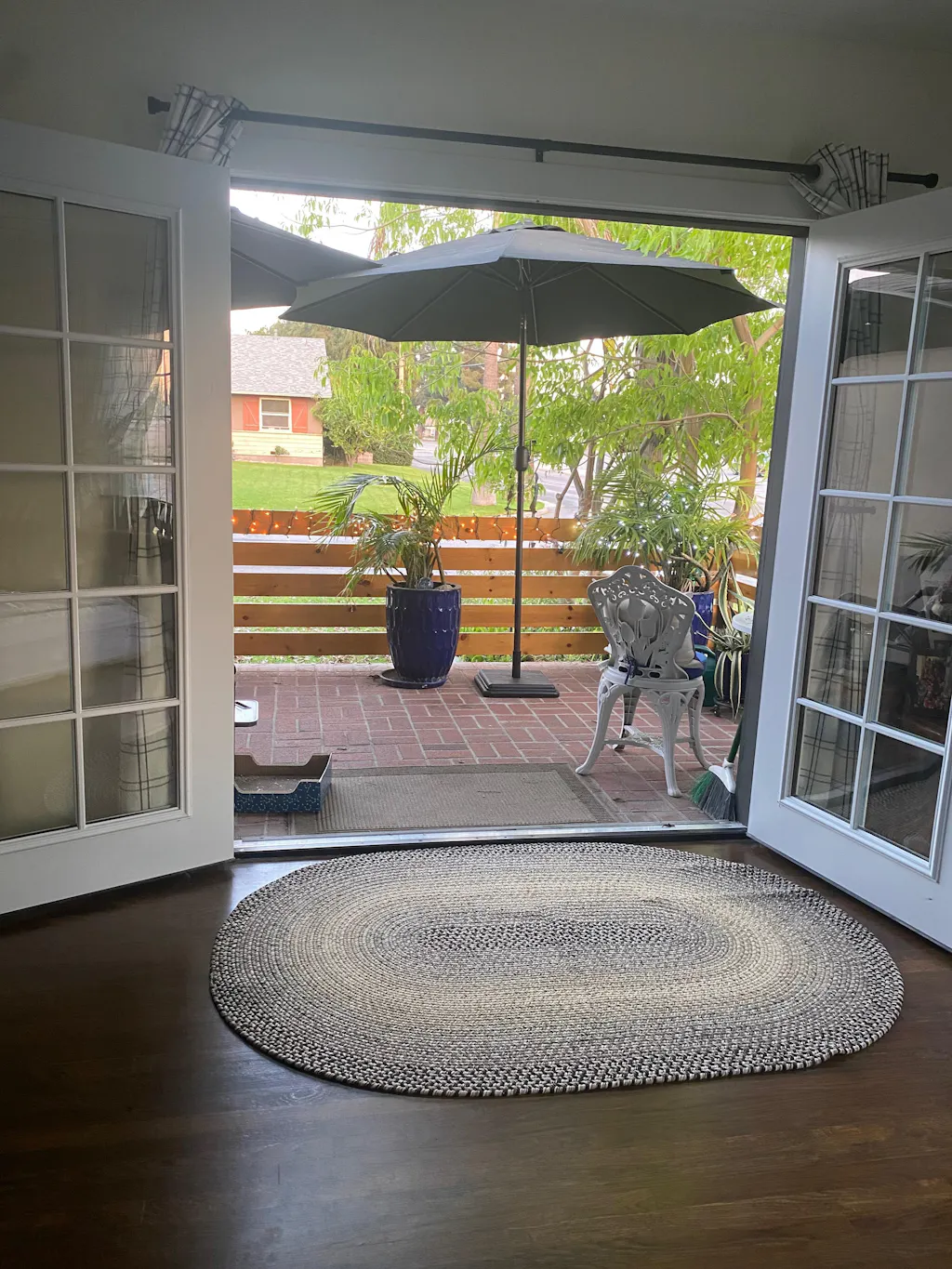
Oval rugs offer the warmth of a traditional shape in a format that suits both rectangular furniture arrangements and narrower rooms. Super Area Rugs’ braided oval rugs from the Rhody Rugs collection come in sizes from 2x3 accent pieces up to large room-size ovals — with handcrafted construction that brings New England artisan character to any space.
Runners come in standard widths of 2’, 2.5’, and 3’, with lengths from 6 to 14 feet. Choose the length so the runner ends 6-18 inches from each wall in hallways, or covers the primary work zone in a kitchen.
Final Tips Before You Buy
- Measure twice, order once. Tape your proposed rug dimensions on the floor before placing any order.
- Go bigger if you’re unsure. The most-regretted rug decisions always come down to “I should have gone larger.”
- Consider the whole furniture grouping, not just the sofa. The rug must accommodate every piece in the seating arrangement.
- Use a rug pad. It extends rug life, prevents slipping, and adds just enough cushion underfoot.
- Think about care. High-traffic rooms call for machine washable or durable braided construction.
Ready to find the right size for your space? Super Area Rugs offers free shipping, a 30-day return policy, and a full range of sizes in braided, machine washable, and sheepskin styles. Shop at superarearugs.com.