
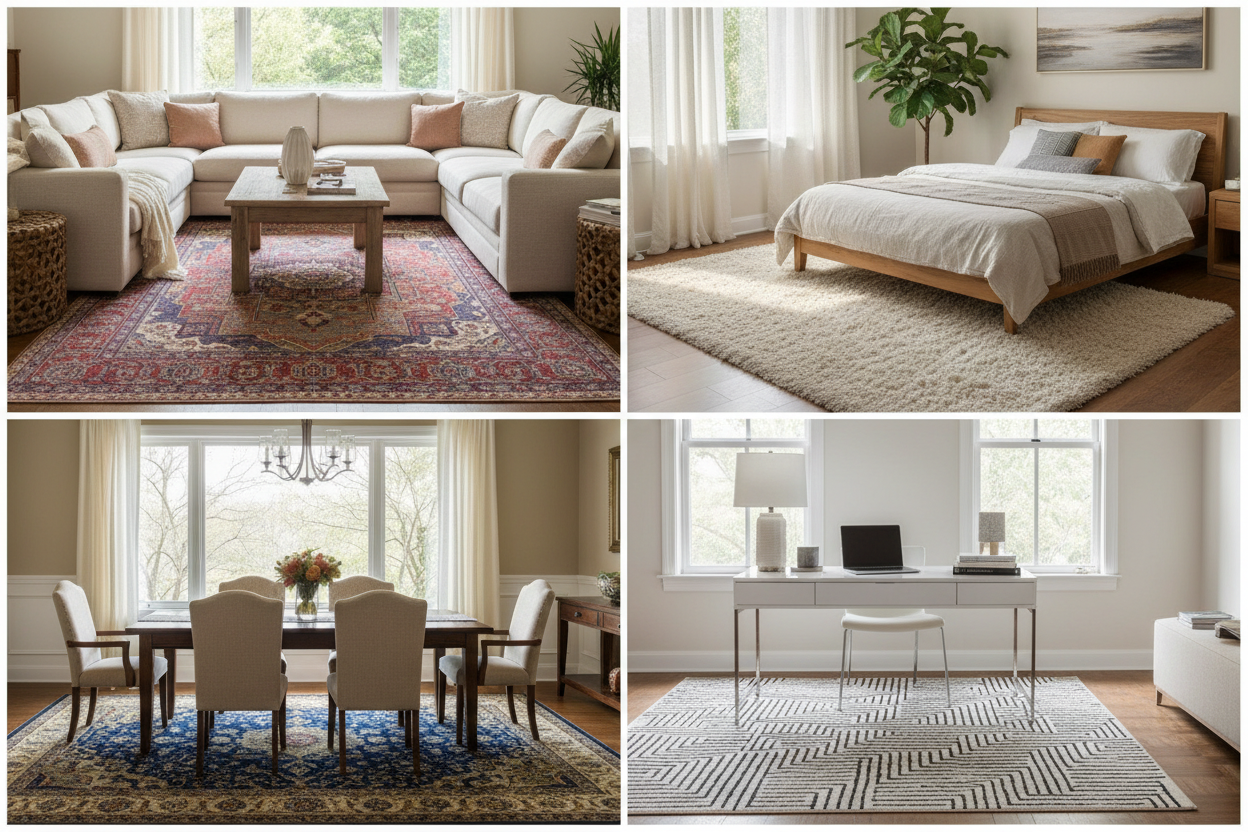
Rug Size Guide: How to Pick the Right Area Rug Size for Every Room
The number one rug mistake people make isn’t the color or the pattern — it’s the size. A rug that’s a few inches too small makes a whole room feel unfinished, no matter how beautiful the rug itself is. The good news: getting it right comes down to a handful of simple rules and knowing the standard rug sizes.
This rug size guide walks you through every common area rug size, what each one is actually good for, a quick feet-to-inches conversion chart, and room-by-room placement rules for living rooms, bedrooms, and dining rooms. By the end you’ll know exactly which size to buy before you ever add one to your cart.
Standard Rug Sizes (and What Each One Is For)
Most area rugs are sold in a set of standard rug sizes. Three of them — 5x8, 8x10, and 9x12 — account for the majority of rugs sold, because they fit the most common living rooms, bedrooms, and dining rooms. Here’s the full lineup and where each size shines:
| Rug Size (ft) | Best For |
|---|---|
| 2x3 | Entryways, kitchen sink, bedside accent |
| 3x5 | Small entryways, reading nooks, in front of a vanity |
| 4x6 | Apartment living rooms, under a coffee table, small bedrooms |
| 5x8 | Small living rooms, twin beds, home offices |
| 6x9 | Medium living rooms, full/queen beds, small dining rooms |
| 8x10 | The most versatile size — medium living rooms, queen beds, 6-seat dining |
| 9x11 / 9x12 | Large living rooms, king beds, open floor plans, all-legs-on layouts |
| 10x14 | Great rooms, large sectionals, oversized dining tables |
| 12x15 | Expansive open-concept spaces and large seating groups |
Note that 9x11 and 9x12 are often used interchangeably — both anchor a large living room or a king bed, and the one-foot difference rarely changes which room it suits.
Rug Sizes in Inches: Quick Conversion Chart
Rug sizes are listed in feet, but you’ll want them in inches when you’re measuring with a tape measure or comparing against furniture. Multiply each foot by 12. Here are the most common conversions:
| Size in Feet | Size in Inches | Square Feet |
|---|---|---|
| 2x3 | 24 x 36 in | 6 sq ft |
| 3x5 | 36 x 60 in | 15 sq ft |
| 4x6 | 48 x 72 in | 24 sq ft |
| 5x8 | 60 x 96 in | 40 sq ft |
| 6x9 | 72 x 108 in | 54 sq ft |
| 8x10 | 96 x 120 in | 80 sq ft |
| 9x12 | 108 x 144 in | 108 sq ft |
| 10x14 | 120 x 168 in | 140 sq ft |
Comparing Common Rug Sizes
6x9 vs. 8x10
This is the most common sizing decision shoppers face. An 8x10 covers 80 square feet; a 6x9 covers 54 — so the 8x10 gives you about 48% more coverage. Choose 6x9 for a smaller living room (roughly 11x13 feet or under) where you want the front legs of furniture on the rug. Step up to 8x10 for a medium room or when you want a more grounded, all-legs-on look.
4x6 vs. 5x8
A 4x6 floats nicely in front of a sofa in an apartment or studio, or under a coffee table with the furniture legs off. A 5x8 is the better pick once you want at least the front legs of your seating on the rug, or for a twin bed. If you’re between the two and have the floor space, size up — too-small is the more common regret.
8x10 vs. 9x12
Both are large-room rugs. Go 8x10 for a medium living room or a queen bed with a front-legs-on layout. Go 9x12 (or 9x11) for a large living room, a king bed, or any time you want every piece of furniture sitting fully on the rug. The extra foot in each direction makes a real visual difference in a big, open space.
What Size Rug for a Living Room?
The living room is where rug size matters most — it’s usually your largest rug and it sets the tone for the whole seating area. The size you need depends on your room dimensions and how you want furniture to sit on it.
- All legs on: In a large living room or open floor plan, pick a rug big enough for every furniture leg to sit on it — typically 9x12 or larger. This is the most pulled-together look.
- Front legs on: The most popular and budget-friendly approach. An 8x10 anchors the seating group with the front legs of your sofa and chairs on the rug.
- Floating: In a small or apartment living room, a 5x8 or 6x9 placed in front of the sofa works, especially if the sofa backs up to a wall.
A good rule of thumb: leave 12 to 18 inches of bare floor between the edge of the rug and the walls to frame the room without overwhelming it, and make the rug at least 6 to 8 inches wider than your sofa on each side.
What Size Rug for a Bedroom?
In the bedroom, the bed is the anchor. The goal is a rug that extends 18 to 24 inches past both sides and the foot of the bed, so your feet land on something soft when you get up. Match the rug to your mattress:
| Bed Size | Recommended Rug |
|---|---|
| Twin | 5x8 (centered or under lower two-thirds) |
| Full / Queen | 8x10 (most popular) or 6x9 |
| King / Cal King | 9x12 (or 9x11) |
Short on space or budget? Two runners on either side of the bed, or a single runner at the foot, give you the same soft landing without a full room-size rug.
What Size Rug for a Dining Room?
For a dining room, the rule is simple: every chair should stay fully on the rug even when pulled out. Measure your table and add at least 24 inches on every side — that’s the chair clearance. A 6-seat rectangular table usually needs an 8x10; a larger table or one that extends with a leaf often calls for a 9x12. Choose a low-pile, flatweave, or washable rug so chairs slide easily and crumbs are easy to clean up.
Frequently Asked Questions
What is the most common area rug size?
The 8x10 is the single most popular and versatile size. It fits medium living rooms with a front-legs-on layout, works under a queen bed, and suits a 6-seat dining table. If you could only own one rug size, 8x10 is the safest pick.
What are the standard rug sizes?
Standard rectangular rug sizes are 2x3, 3x5, 4x6, 5x8, 6x9, 8x10, 9x12, 10x14, and 12x15 feet. Common square sizes are 6x6, 8x8, and 10x10, and round rugs run from 4 to 10 feet in diameter.
What size is a 9x11 rug in inches?
A 9x11 rug measures 108 x 132 inches and covers 99 square feet. It’s a large-room size, ideal for a sizable living room or under a king bed, and is often interchangeable with a 9x12.
Is a 6x9 or 8x10 rug bigger?
An 8x10 is bigger — 80 square feet versus 54 for a 6x9, about 48% more coverage. Choose 6x9 for smaller living rooms and 8x10 for medium rooms or a more grounded, all-legs-on look.
How much bare floor should show around a rug?
Aim for 12 to 18 inches of bare floor between the rug edge and the walls in most rooms. This frames the space and keeps the rug from looking like wall-to-wall carpet.
What size rug fits under a queen bed?
An 8x10 is the go-to for a queen bed. It extends roughly 18 to 24 inches beyond both sides and the foot of the bed, giving you a soft landing and a polished, balanced look.
Final Thoughts
Once you know the standard sizes and the simple room rules — front legs on for living rooms, 18 to 24 inches around the bed, full chair clearance in the dining room — picking the right rug size stops being a guessing game. Measure your space first, size up when you’re between two options, and you’ll get it right the first time. When you’re ready to shop, browse the full range of sizes and shapes at superarearugs.com to find the perfect fit for every room.